
Vietnamese - English bilingual international conference, 33 papers selected from 68 proposals.
Opening Session
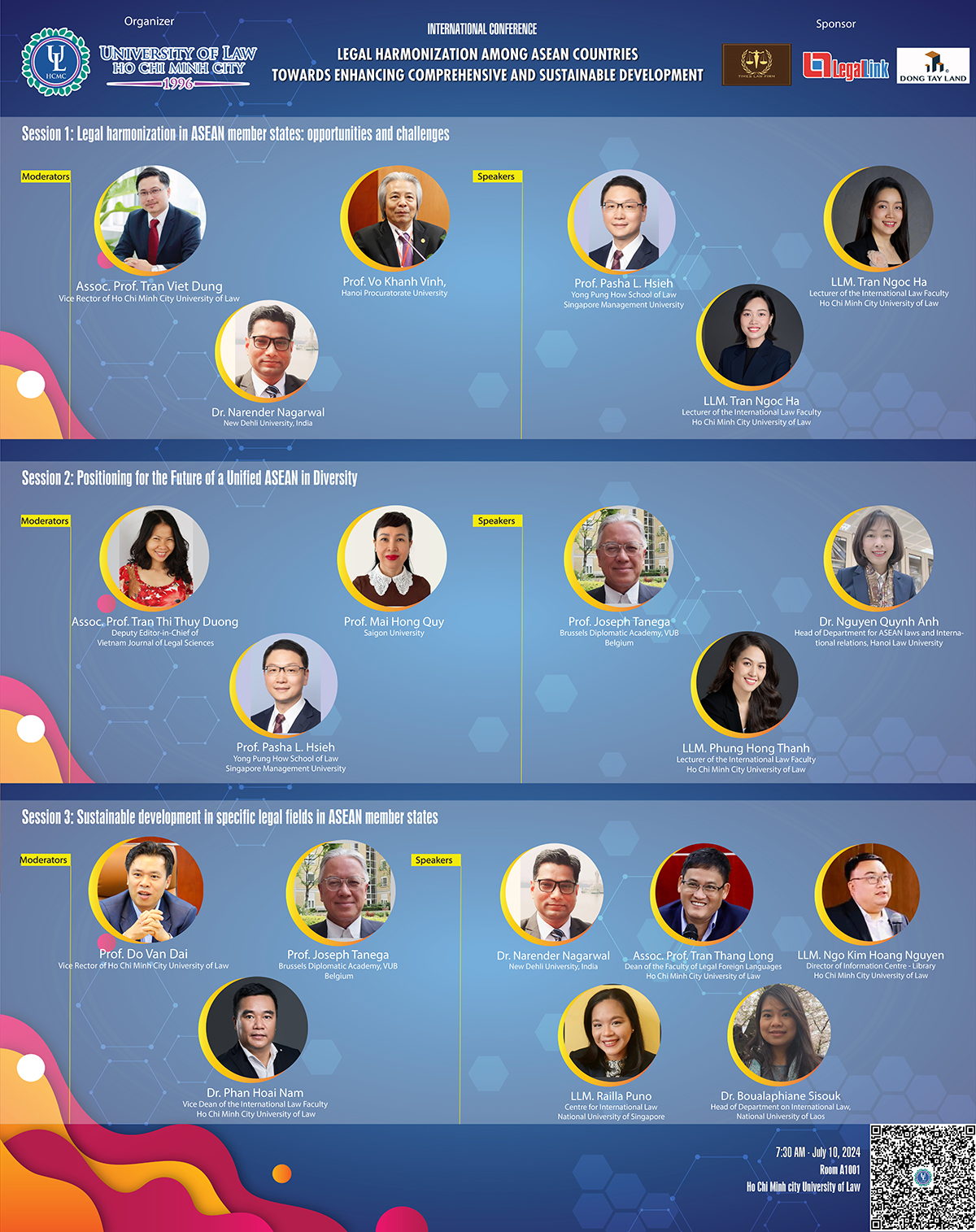
Session 1: Harmonization of laws in ASEAN: opportunities and challenges
-
Barriers to the process of legal harmonization in the ASEAN CommunityMSc. Tran Ngoc HaLecturer, Faculty of International Law, City University of Law. Ho Chi Minh
-
Comparative law and the process of legal harmonization in the ASEAN CommunityMSc. Tran Thi Ngoc HaLecturer, Faculty of International Law, City University of Law. Ho Chi Minh
-
Green Zone Institutions: Harmonizing new sustainable trade normsProfessor. Dr. Pasha L. HsiehYong Pung How Law School, Singapore Management University (Singapore Management University)
Session 2: Positioning the future for an ASEAN united in diversity
-
Nuclear security in ASEAN: From theoretical principles to practical implementationProfessor. Dr. Joseph TanegaFree University of Brussels (Vrije Universiteit Brussel), Belgium
-
Harmonize investment laws towards a common legal foundation within the ASEAN frameworkDr. Nguyen Quynh AnhHead of Department of ASEAN Law and International Links, Hanoi Law University
-
Assess the ability of ASEAN countries to harmonize laws in the field of International JusticeMSc. Phung Hong ThanhLecturer, Faculty of International Law, City University of Law. Ho Chi Minh
Session 3: Sustainable development in specific legal fields in ASEAN
-
Towards harmonization of labor laws in ASEAN - perspective from VietnamDr. Narender NagarwalNew Delhi University, India
-
Harmonizing ASEAN laws on international transfers of personal data: Experience from the European UnionAssociate Professor. Dr. Tran Thang LongHead of Department of Legal Foreign Languages, T, City University of Law. Ho Chi Minh
-
Harmonization of trademark law in the ASEAN region: Challenges and progressMSc. Ngo Kim Hoang NguyenDirector of Information Center - Library, Lecturer of International Law Faculty, City University of Law. Ho Chi Minh
-
Energy policy and governance issues to adapt to climate change in Southeast Asia: Lessons from the energy crisis in the European UnionMSc. Railla PunoCenter for International Law, National University of Singapore (NUS)
-
Implementing international conventions in the context of the Convention on the Elimination of All Forms of Discrimination against Women (CEDAW) in ASEAN: A Case Study from Lao PDRDr. Boualaphiane SisoukHead of International Law, Faculty of Law and Political Science, National University of Laos (NUOL)
Closing Session
Session 1: Harmonization of laws in ASEAN: opportunities and challenges
ASEAN increasingly asserts its role and influence in the region and the world. With the goal of building a unified community in diversity based on rules-based rules, right from the early days of building a common community, ASEAN member states were soon clearly aware of the importance of legal harmonization. Legal harmonization is an indispensable parallel process for the integration process in ASEAN. Through many different measures, ASEAN countries have achieved certain achievements to bring the legal systems of member countries closer together. However, the process of legal harmonization in the ASEAN community has been facing many barriers such as diversity in legal cultural traditions, differences in development levels among member countries; the impact of religious factors and development policies of countries; Restrictions on legislative activities and internal laws in member states... ASEAN needs to make efforts to cooperate and coordinate more closely to create a common legal framework to ensure the comprehensive and sustainable development of the entire region.
Harmonization of laws in the ASEAN region is an inevitable requirement and requirement of the integration process in ASEAN. The integration process requires countries to move towards using a common "language", including law. Within the scope of the article, the authors will present the legal regulations within the framework of ASEAN and analyze the role of Comparative Law in the process of legal harmonization in the ASEAN Community.
The Green Zone Institution aims to coordinate environmental management in association with economic integration, promoting legal harmonization at both regional and global scales. This study analyzes green regionalism in international law by examining how emerging agreements influence new commercial sustainability norms, especially green initiatives promoted by the European Union, the United States, and the Association of Southeast Asian Nations. The authors believe that understanding these dynamics is very important to navigate sustainable development linked to the environment and contribute to promoting harmonization of related legal aspects.
Session 2: Positioning the future for an ASEAN united in diversity
Nuclear security is always an issue of concern around the world, especially in the context of geopolitical changes and huge economic fluctuations. The issue of nuclear security in ASEAN has also become an important topic in the sustainable development of the Southeast region. This study aims to comprehensively investigate the philosophical factors that impact human responses to nuclear issues, including factors such as (i) cultural norms, (ii) ideological beliefs, and (iii) customary factors. The article will examine how some ASEAN countries, specifically Vietnam, Indonesia and Malaysia, have responded to international conventions on nuclear security and the implications of their establishment of legal frameworks in this area. Through research, the authors will aim to propose some measures to strengthen and improve the effectiveness of nuclear security in ASEAN countries.
In the process of integration and development of ASEAN, to create a transparent, easy and favorable investment environment for investors, harmonization of investment laws among member countries becomes an urgent requirement to facilitate the implementation process. However, because ASEAN member states have differences in political institutions, legal systems, cultures and economic development levels, it affects the implementation of the provisions of the general agreement and each country's commitments in ASEAN investment agreements. This article analyzes and evaluates the importance of harmonizing investment laws, emphasizing that creating a uniform legal framework is a key factor to promote investment and economic development in the region. At the same time, the authors also conducted research on the investment laws of some ASEAN countries such as Singapore, Indonesia, Philippines, Thailand and Vietnam to compare and evaluate current regulations in each country's legal system. From there, point out the opportunities and challenges in the process of legal harmonization in ASEAN.
In the process of regional and world integration, the number of civil disputes with foreign elements is increasing and becoming more complex... causing many difficulties and challenges in the resolution process such as the issue of determining the jurisdiction of national courts or difficulties in implementing mutual legal assistance activities or resolving legal conflicts between member states... from that point on, legal harmonization has become very important for regional economic cooperation institutions, including those of ASEAN. The article focuses on researching the issue of legal harmonization in areas associated with personal factors such as marriage and family, inheritance... according to the regulations of three ASEAN countries: Singapore, Vietnam, Thailand; Evaluate basic similarities and differences in regulating civil relations with foreign elements. From there, an assessment is made on the ability of ASEAN countries to form a common legal framework on international justice.
Session 3: Sustainable development in specific legal fields in ASEAN
Over the past years, Vietnam has increasingly affirmed its position in Southeast Asia through important contributions to the industrialization process, economic expansion and infrastructure development of the entire region. In the process of modernization and globalization to integrate more with the world in general and ASEAN in particular, the establishment of more factories and businesses attracting foreign investment has led to labor migration within ASEAN. This raises the issue of ensuring fair treatment and equality in access to all social security provisions for migrant workers as prescribed by the ILO (International Labor Organization). Therefore, a cohesive, harmonious and cooperative master plan to protect the rights of workers in ASEAN is very important to achieve the goal of sustainable economic development.
ASEAN regional economic integration is increasingly deepening, promoting the connection process among ASEAN countries towards a comprehensive ASEAN Community of economic development cooperation, meeting the challenges of the digital economy. In that context, harmonization of laws on personal data protection, especially in the field of data transfer abroad, becomes necessary and urgent. Based on research on the experiences of the European Union (EU), the article discusses lessons for ASEAN in this process. The article includes the following main issues: (i) discusses the importance of personal data protection in the digital economy era and the role of harmonization of data transfer laws for ASEAN; (ii) analyze key EU principles and regulations on data transfer, (iii) research the current ASEAN legal framework on data transfer; (iv) analyze challenges and opportunities for ASEAN in applying EU experience; and (v) propose solutions to promote harmonization of ASEAN laws on international data transfers.
Legal harmonization can be considered a stable method for the exchange of goods, trade, and services between countries to become more free and open. Aiming for a common legal framework with common characteristics to minimize disparities in regional legal fields, the Association of Southeast Asian Nations (“ASEAN”) has determined to build a legal structure capable of regulating key issues affecting that common goal. Cooperation related to intellectual property (IP) issues has seen steady growth, influencing the development of intellectual property systems in each country and the overall socio-economic progress of the region. Specifically in the field of trademarks, businesses have faced difficulties in related procedures and policies due to the need to harmonize legal systems between countries. Therefore, thorough research on this issue and the development of feasible solutions are necessary. In the common spirit of ASEAN to eliminate differences in the laws of countries, this article aims to identify challenges and propose recommendations to harmonize trademark law in ASEAN.
Europe has experienced an unprecedented energy crisis with prices reaching an all-time high in 2022. Gas prices in Europe rose 1,000% from April 2020 to January 2021 and rose further in 2022, leaving governments in Europe to pay or reserve more than $800 billion to support consumers. Although severely impacted by the war situation in Ukraine and the COVID-19 pandemic, many people believe that this crisis has been going on for a long time. Europe has relied on a single supplier for the majority of its energy needs and is bound by the long-term contracts that characterize fossil fuel markets. Furthermore, despite the looming climate crisis and the European Union's (EU) commitment to achieving net zero emissions by 2050 under the Paris Agreement, the pace of renewable energy development in the region remains very limited. Many scholars agree that early investment in renewable energy development could have reduced Europe's dependence on Russian gas, but as of 2020, only about 20% of energy used for heating and cooling and 10.2% of transportation came from renewable sources. Although prices have fallen significantly in 2023, they remain well above historical averages in both Asia and Europe, with natural gas markets expected to return to strong growth in 2024. How can Southeast Asia learn from the EU's experience and avoid a similar energy crisis scenario? Considered lagging behind on climate and energy policy, Southeast Asian countries already face similar risks to Europe. Most Asian countries rely heavily on one fossil fuel supplier and are the only region where natural gas consumption is expected to increase over the next 20 years. The prolonged war between Russia and Ukraine could also affect stability in the region due to its dependence on crude oil, which accounts for the majority of the region's energy mix as of 2020. The Association of Southeast Asian Nations (ASEAN), as an international organization, has for many years cooperated on energy-related issues. The theme of the ASEAN Energy Cooperation (APAEC) Action Plan 2015-2025 is to strengthen energy connectivity and market integration to achieve energy security, accessibility, affordability and sustainability. This is consistent with the goal of pursuing net-zero carbon emissions as soon as possible in the second half of this century. However, unlike the EU, ASEAN mainly only makes recommendations based on political relations and mutual trust for member states to implement commitments and agreements without the existence of a legislative institution like that of the European Union. This article aims to analyze the causes of the energy crisis in Europe, examine the European response and compare them with the risks and challenges facing the ASEAN energy market. The article also analyzes and compares the EU and ASEAN as international organizations, especially ASEAN's regional governance method, and examines the extent to which ASEAN can implement energy policies resilient to climate change. This article will conclude with recommendations on ASEAN climate-resilient energy policy and regional governance to promote green investment by investors and market mechanisms. This will enable countries to fulfill their commitments under the Paris Agreement to ensure energy security, affordability and sustainability, while maintaining peace, stability and prosperity in the region.
Abstract —
Time: 10/07/2024